

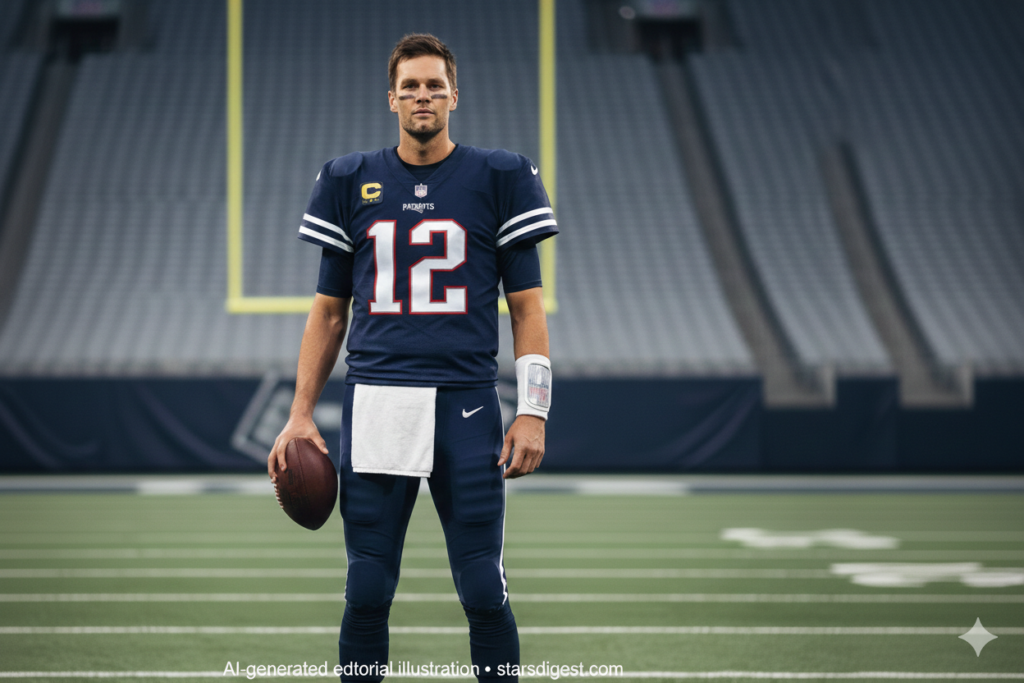
Basic Information
Name: Tom Brady
Caption: American former professional football quarterback and NFL legend
Birth Name: Thomas Edward Patrick Brady Jr.
Born: 3 August 1977 — Age: 48 (as of 2026)
Birth Place: San Mateo, California, United States
Nationality: American
Other Names: TB12, The GOAT (Greatest of All Time nickname)
Occupation: Former Professional American Football Player, Sports Analyst, Entrepreneur
Years Active: 2000 – 2023 (NFL Playing Career)
Height: 193 cm (6 ft 4 in approx)
Spouse / Partner: Previously married to Gisele Bündchen
Children: Jack Brady, Benjamin Brady, Vivian Brady
Position: Quarterback
College: University of Michigan
Net Worth: Approximately US $300 Million – $350 Million (2025–2026 estimate, excluding long-term media contracts)
Introduction
Tom Brady is widely considered the greatest quarterback in the history of American football and one of the most successful athletes in global sports history. Known for his unmatched longevity, mental toughness, leadership under pressure, and relentless pursuit of perfection, Brady built a career that redefined what was thought possible in professional sports.
Unlike many superstar athletes who are expected to dominate from the start, Brady’s story is one of long-term development, patience, and extreme competitive mindset. From being an overlooked college backup player to becoming the most decorated quarterback in National Football League history, his journey became a symbol of discipline, preparation, and mental resilience.
Across more than two decades in professional football, Brady not only won championships but changed how athletes approach career longevity, physical conditioning, and mental preparation in high-performance sports environments.
Early Life and Childhood
Thomas Edward Patrick Brady Jr. was born on August 3, 1977, in San Mateo, California. He grew up in a sports-loving family where competition and athletic achievement were strongly encouraged. From a young age, Brady was exposed to multiple sports, including baseball, basketball, and football.
During childhood, Brady was a passionate fan of football, especially inspired by legendary quarterbacks of earlier NFL eras. Watching games with family members helped build his early understanding of football strategy and game psychology. Even as a child, he was less focused on raw athletic dominance and more fascinated by decision-making, leadership, and game intelligence.
In high school, Brady played both baseball and football, showing strong potential in both sports. At one point, he was even drafted in baseball, but his passion for football and long-term vision pushed him toward pursuing quarterback development.
His early athletic career was not defined by being the most physically dominant player, but rather by steady improvement and mental discipline — traits that would later define his professional career.
College Years — Learning Patience and Competition
Brady attended the University of Michigan, where his college career became one of the most important character-building periods of his life. He spent much of his early college years competing for playing time rather than being a guaranteed starter.
Instead of transferring or giving up, Brady embraced the competition. He focused intensely on film study, physical training, and mastering playbook strategy. When he finally earned starting opportunities, he demonstrated calmness under pressure and strong game management skills.
His college career did not make him a top draft prospect. Many scouts questioned his athleticism and physical upside. However, what many overlooked was his mental strength, leadership ability, and performance in high-pressure situations.
NFL Draft — The Underdog Beginning
Brady entered the NFL as a late draft pick, selected in a position where very few players historically become superstars. At the time, he was not expected to become a franchise quarterback, let alone a future legend.
His early professional years were focused on learning, observing veteran players, and preparing for any opportunity. When that opportunity finally came, he demonstrated exceptional composure and leadership, helping lead his team to unexpected championship success early in his starting career.
This early success did not just change his career — it changed how teams evaluated quarterback potential, placing more value on decision-making, leadership, and mental processing speed.
Rise to Dynasty Era Dominance
As Brady settled into his role as a starting quarterback, he became the central leader of one of the most successful dynasties in professional sports history. Over time, he developed a reputation for performing best in the most high-pressure playoff situations.
His playing style focused on:
Precision passing, rapid decision-making, defensive reading ability, and leadership communication. Instead of relying heavily on mobility or physical improvisation, Brady mastered anticipation, timing, and mental control of games.
His ability to consistently deliver during championship-level games separated him from nearly every other quarterback in NFL history.
Career Longevity and Reinvention
One of Brady’s most remarkable achievements was maintaining elite performance into his 40s, something previously considered nearly impossible for NFL quarterbacks. He achieved this through extreme discipline in nutrition, recovery science, sleep optimization, and physical conditioning.
He became a pioneer in athlete longevity, influencing not just football players but athletes across multiple sports. His training philosophy emphasized flexibility, injury prevention, and long-term physical sustainability rather than short-term strength focus alone.
Late Career Success and Legacy Cementing
Late in his career, Brady made a major team change, which was widely considered a massive risk at his age. Instead of declining, he led his new team to championship success, proving that his leadership and football intelligence were transferable beyond a single system or coaching structure.
This achievement further solidified his legacy as the most successful quarterback in NFL history and one of the greatest competitors in sports history.
Leadership Style and Mental Approach
Brady’s leadership style combined emotional intensity with deep preparation. He was known for demanding excellence from teammates while also leading through example. His study habits, training commitment, and game preparation routines became legendary inside locker rooms.
His mental approach emphasized:
Confidence under pressure, emotional control, strategic adaptability, and long-term goal focus. Many younger quarterbacks studied his approach as a blueprint for elite performance.
Business Ventures and Brand Influence
Outside football, Brady built a major business and lifestyle brand through fitness, nutrition, apparel, and sports performance products. His TB12 brand became associated with high-performance athlete lifestyle optimization.
He also transitioned into sports media and broadcasting opportunities, expanding his career into long-term post-playing influence in sports entertainment and analysis.
Personal Life and Public Image
Brady’s personal life has often been in global media due to his high-profile marriage and global celebrity status. Despite intense public attention, he maintained strong focus on family, career longevity, and professional discipline.
Fatherhood became a central emotional motivation throughout his later career years.
Awards and Achievements
Throughout his career, Brady won multiple championship titles, individual player awards, and postseason performance records. He holds numerous passing records and playoff performance milestones that may stand for decades.
Career Evolution Timeline
Tom Brady’s career reflects a long-term progression from overlooked draft pick to dynasty leader, then to veteran longevity pioneer, and finally to global sports legend and post-playing era influence figure.
Legacy and Historical Importance
Tom Brady redefined quarterback longevity, championship consistency, and leadership standards in professional football. He helped prove that mental performance, preparation, and discipline could be as important as physical talent in elite sports success. He also changed how teams evaluate long-term quarterback development and how athletes approach career sustainability. His influence extends beyond football into global sports performance culture and athlete longevity science.
Conclusion
Tom Brady’s story is one of discipline, belief, and long-term excellence. From being underestimated early in his career to becoming the most decorated quarterback in football history, his journey represents the power of preparation meeting opportunity.
His legacy will likely be studied not only for championships and statistics, but for how he changed athlete career expectations across all major sports. Even after retirement, his influence on sports culture, performance science, and leadership philosophy continues shaping the next generation of elite athletes.