
Basic Information
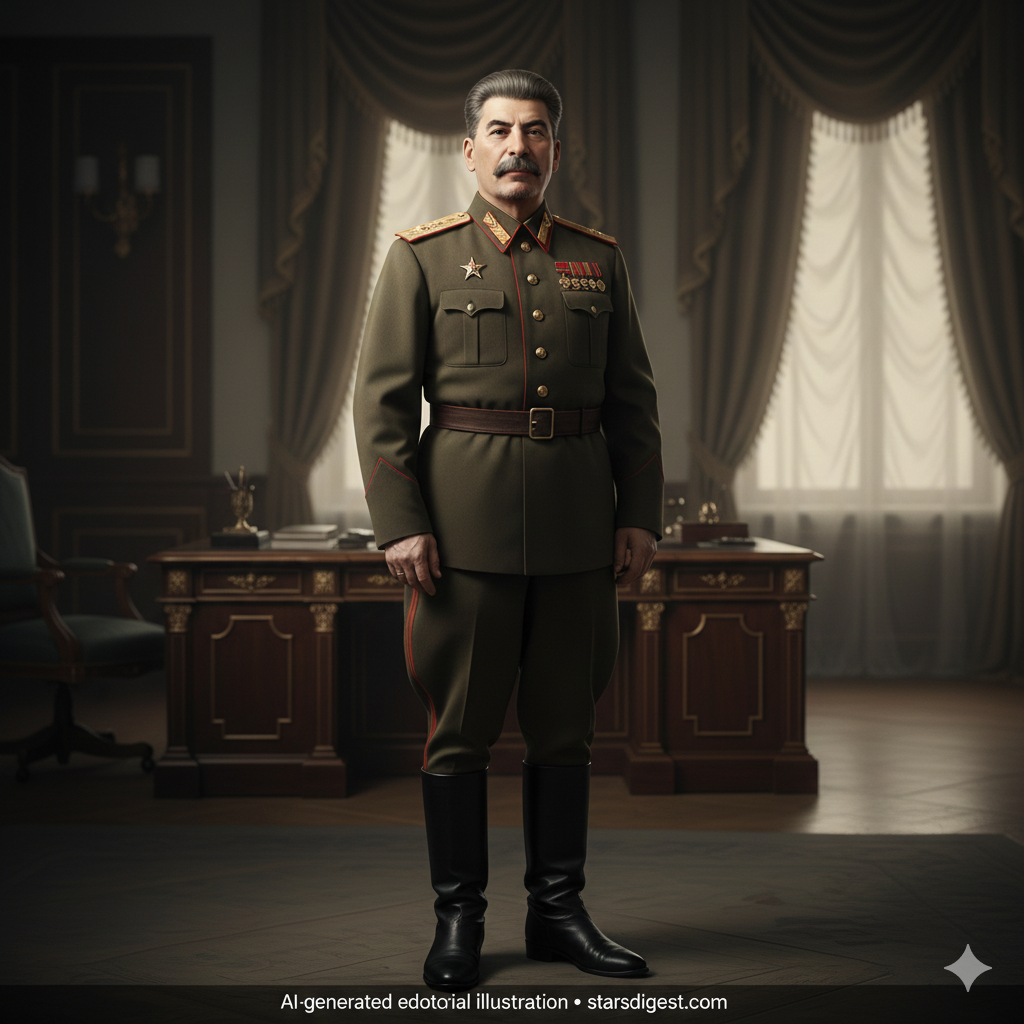
Name: Joseph Stalin
Caption: Soviet political leader and General Secretary of the Communist Party of the Soviet Union
Birth Name: Ioseb Besarionis dze Jughashvili
Born: 18 December 1878
Birth Place: Gori, Georgia (Russian Empire at the time)
Nationality: Soviet (Later political identity); Georgian by birth
Other Names: Koba (Revolutionary alias), Stalin (“Man of Steel”)
Occupation: Revolutionary, Politician, Dictator, Party Leader
Years Active: Early 1900s – 1953
Height: Approximately 165–168 cm (5 ft 5 in – 5 ft 6 in approx historical estimates)
Spouse / Partner: Ekaterina Svanidze (First wife, deceased), Nadezhda Alliluyeva (Second wife, deceased)
Children: Yakov Dzhugashvili, Vasily Stalin, Svetlana Alliluyeva
Political Role: Leader of the Soviet Union (Mid-1920s – 1953)
Net Worth: Not applicable (State-controlled political system; personal wealth not measured like modern leaders)
Introduction
Joseph Stalin was one of the most influential and controversial political figures of the 20th century and one of the dominant leaders of the Soviet Union during a period of massive global transformation. Known for his role in industrializing the Soviet Union, leading the country during World War II, and consolidating political power through strict authoritarian control, Stalin’s leadership shaped world history in profound and complex ways.
What makes Stalin historically significant is the scale of his political and military impact. Under his rule, the Soviet Union transformed from a largely agrarian society into a major industrial and military superpower. At the same time, his rule was marked by political repression, purges, and policies that caused widespread suffering and loss of life.
His story represents power, ideology, and the extreme consequences of centralized authoritarian governance. From a poor childhood in the Russian Empire to becoming one of the most powerful political leaders in history, Stalin’s life reflects ambition, ideology, and historical controversy.
Early Life and Childhood
Joseph Stalin was born on December 18, 1878, in Gori, Georgia, which was part of the Russian Empire at the time. He grew up in poverty. His father worked as a cobbler, while his mother worked as a domestic worker and strongly encouraged his education.
His childhood included illness, physical hardship, and a strict household environment. Despite difficult conditions, Stalin showed strong academic ability and was eventually sent to religious school with hopes he would become a priest.
However, during his teenage years, he became interested in revolutionary political ideas, particularly those criticizing the Russian monarchy and social inequality.
Entry Into Revolutionary Politics
During his early adulthood, Stalin became involved in underground revolutionary movements opposing the Tsarist Russian government. He adopted revolutionary aliases and participated in political organizing and underground operations.
During this period, he developed strong reputation for discipline, secrecy, and organizational skill. He was arrested multiple times and spent periods in exile, which was common among revolutionary activists of that era.
Russian Revolution and Rise Within Communist Party
After the Russian Revolution, Stalin rose through the Communist Party ranks. He became known for strong administrative ability and political strategy skills.
Rather than becoming famous as a public speaker or theorist, he built influence through internal party organization and strategic alliances.
Consolidation of Power — Becoming Soviet Leader
After the death of the Soviet Union’s founding leader, Stalin gradually consolidated power. Through political maneuvering, party restructuring, and elimination of rivals, he became the dominant leader of the Soviet Union.
This period marked the beginning of one of the most centralized political power systems in modern history.
Industrialization and Economic Transformation
Stalin led massive industrialization programs aimed at turning the Soviet Union into a modern industrial power. These programs rapidly expanded heavy industry, military manufacturing, and infrastructure development.
However, these policies also caused severe hardship, including forced labor systems and agricultural collectivization that led to famine and major population suffering.
Political Repression and Purge Era
One of the most controversial aspects of Stalin’s leadership was widespread political repression. During his rule, political purges targeted government officials, military leaders, intellectuals, and civilians suspected of disloyalty.
Millions of people were imprisoned, exiled, or executed during this period. This remains one of the most heavily debated and studied periods in modern political history.
World War II Leadership — Global Military Impact
During World War II, Stalin led the Soviet Union through one of the most destructive conflicts in history. The Soviet Union played a major role in defeating Nazi Germany on the Eastern Front.
The war transformed the Soviet Union into a global superpower and reshaped global geopolitical balance.
Post-War Superpower Expansion
After World War II, Stalin helped establish the Soviet Union as one of the two dominant global superpowers, shaping early Cold War geopolitical structure.
Leadership Style and Political Philosophy
Stalin’s leadership style was highly centralized, authoritarian, and based on strict party control. He emphasized state power, industrial strength, and military readiness above individual political freedoms.
Personal Life and Personality
Historically, Stalin was described as extremely private, strategic, and emotionally controlled. He trusted very few people and maintained tight control over political and military leadership.
Death and Historical Reassessment
Stalin died in 1953. After his death, later Soviet leadership publicly criticized many of his policies, beginning a period of political reassessment and reform.
Career Evolution Timeline
Stalin’s life evolved from poor Georgian child to religious student, then to underground revolutionary, then to Communist Party strategist, then to Soviet supreme leader, and finally to one of the most powerful political figures of the 20th century.
Legacy and Historical Importance
Joseph Stalin remains one of the most studied and debated political figures in modern history. He helped transform the Soviet Union into a global superpower but also led one of the most repressive political regimes of the modern era. His legacy remains complex, involving industrial development, wartime leadership, and severe political repression.
Conclusion
Joseph Stalin’s story is one of power, ideology, and global historical impact. From poverty in the Russian Empire to leading one of the most powerful nations in the world, his life reflects the extremes of political authority and historical transformation.
His legacy continues shaping political history discussions, Cold War studies, and global debates about authoritarian leadership. Joseph Stalin remains one of the most historically significant and controversial leaders of the modern era.