

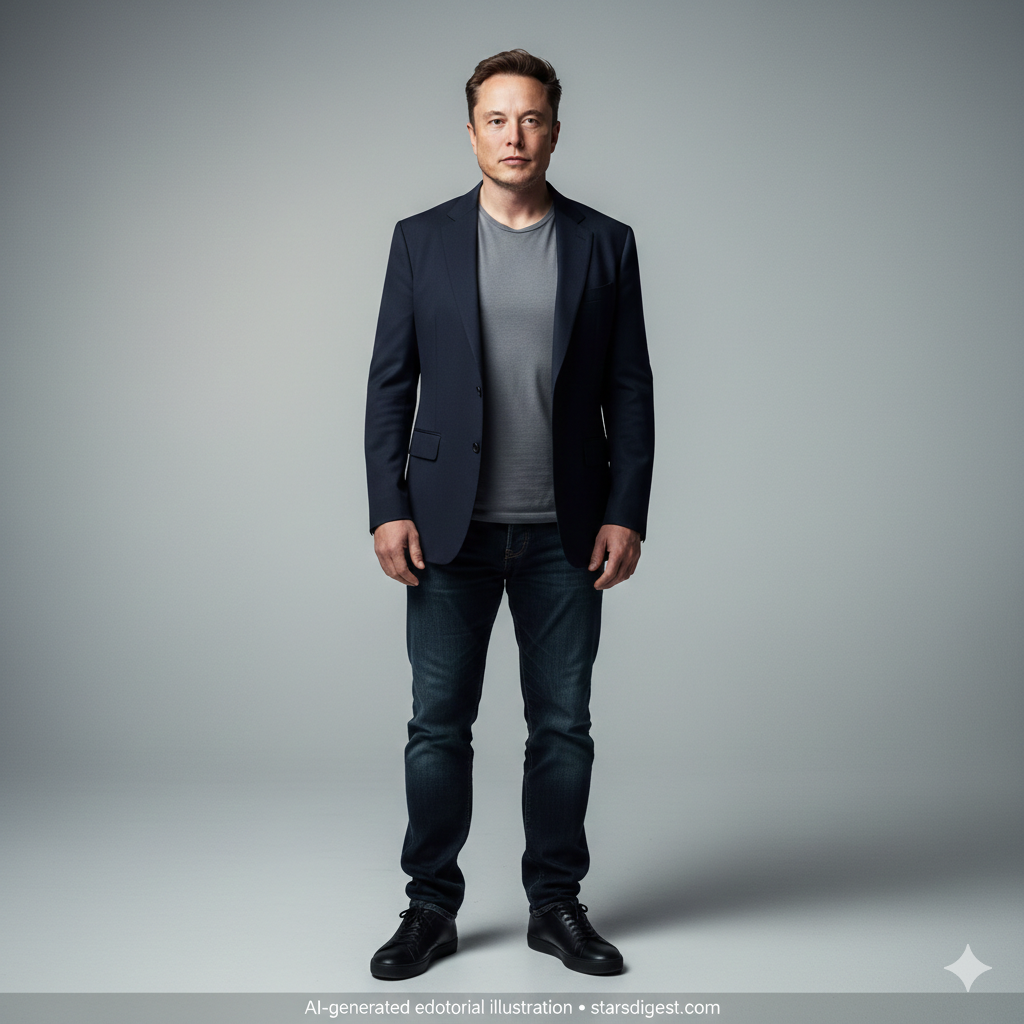
Basic Information
Name: Elon Musk
Caption: Business magnate, investor, and technology entrepreneur known for Tesla, SpaceX, and AI ventures
Birth Name: Elon Reeve Musk
Born: 28 June 1971 — Age: 54 (as of 2026)
Birth Place: Pretoria, South Africa
Nationality: South African-born (later became U.S. citizen)
Other Names: Technoking of Tesla (unofficial corporate title), World’s Richest Person (status in recent years)
Occupation: Entrepreneur, Engineer, Investor, CEO (Tesla, SpaceX), Founder (xAI, Neuralink, The Boring Company)
Years Active: 1995 – Present
Height: Approx. 188 cm (6 ft 2 in approx)
Spouse / Partner: Previously married multiple times (including Talulah Riley); previously partnered with Grimes
Children: Multiple children (publicly known 10+ as of mid-2020s)
Position / Field: Technology, Space Exploration, Artificial Intelligence, Automotive, Energy
College:
- Queen’s University (Canada)
- University of Pennsylvania — Bachelor’s degrees in Physics & Economics
Net Worth: Approximately US $619 Billion – $727 Billion (early 2026 estimates)
Early Life and Background
Elon Reeve Musk was born on June 28, 1971, in Pretoria, South Africa. From a young age, he demonstrated strong technical curiosity, teaching himself programming and selling a simple computer game called Blastar at age 12. His childhood combined intellectual achievement with social challenges, and he often spent long periods reading science fiction and technical material, which later influenced his futuristic ambitions.
Musk later moved to Canada and eventually to the United States to pursue education and business opportunities. He attended Queen’s University in Canada before transferring to the University of Pennsylvania, where he earned degrees in economics and physics. His educational background would later shape his approach to engineering-driven entrepreneurship rather than purely financial business leadership.
He became a U.S. citizen in 2002 while continuing to maintain strong international business ties.
First Businesses: Zip2, X.com, and PayPal Era
Musk’s entrepreneurial journey began during the 1990s internet boom. His first major company was Zip2, an online city guide software company that provided business directories and maps for newspapers. The company was eventually sold, giving Musk his first significant financial success.
He then founded X.com, an online financial services and payments company. This venture later evolved into PayPal, which became one of the most influential early digital payment platforms and was eventually acquired by eBay. This sale provided Musk with capital that enabled him to pursue far more ambitious projects in space, energy, and transportation.
Vision Expansion: SpaceX and the Space Industry
In 2002, Musk founded SpaceX (Space Exploration Technologies Corp.). His primary goal was not simply profit but lowering the cost of space travel and eventually enabling human colonization of Mars.
SpaceX initially struggled, facing multiple failed rocket launches and near bankruptcy. Musk personally invested much of his fortune to keep the company alive. Over time, SpaceX became one of the most important private aerospace companies in the world, pioneering reusable rocket technology and launching satellites for global internet services via Starlink.
By the mid-2020s, SpaceX was valued in the hundreds of billions of dollars and became central to Musk’s long-term plan of making humanity a multi-planetary species.
Tesla and the Electric Vehicle Revolution
Musk did not found Tesla but became its largest investor in 2004 and eventually its CEO in 2008. Under his leadership, Tesla transitioned from a niche electric vehicle startup into a dominant force in the global EV market.
Tesla helped accelerate global adoption of electric vehicles, forcing traditional automakers to invest heavily in EV technology. The company also expanded into solar energy and battery storage through acquisitions such as SolarCity.
Tesla became one of the most valuable automakers in history and played a major role in Musk becoming the world’s richest person at various points.
Expanding Into Infrastructure and Neurotechnology
Musk expanded into multiple high-risk, high-impact technology sectors:
Neuralink
Founded in 2016, Neuralink focuses on developing brain-computer interfaces. The company initially targeted treatment for neurological diseases, with long-term goals of human cognitive enhancement and integration with artificial intelligence.
The Boring Company
Founded in 2016–2017, this company aims to build underground tunnel transportation networks to reduce urban traffic congestion.
xAI and Artificial Intelligence
Musk founded xAI to compete in advanced AI development and integrate AI across his technology ecosystem.
Social Media and X (Formerly Twitter)
In 2022, Musk acquired Twitter for approximately $44 billion and later rebranded it as X. His goal was to transform the platform into a multi-purpose digital platform for communication, finance, and content distribution.
The acquisition generated massive debate around free speech, platform moderation, and digital media responsibility. After restructuring and rebranding, the platform became part of Musk’s broader technology ecosystem and was later merged with his AI efforts.
Net Worth and Financial Influence
Musk has repeatedly ranked among the richest individuals in world history. As of early 2026, real-time estimates placed his wealth in the hundreds of billions, with some reports indicating even higher valuations depending on company performance and mergers.
Recent reporting suggests his wealth surged dramatically following major company integrations and valuations exceeding $1 trillion for combined ventures.
Recent Strategic Moves (2025–2026)
Recent developments show Musk increasingly merging his companies into a unified technological ecosystem combining space technology, AI, and communication networks.
One major move was the merging of SpaceX and xAI, creating a massive vertically integrated technology structure combining rockets, AI, satellite internet, and social media platforms.
This strategy reflects Musk’s long-term vision of integrating space infrastructure with advanced computing and artificial intelligence.
Leadership Style and Public Persona
Musk is known for intense work ethic, risk tolerance, and hands-on engineering involvement. He has also been controversial for his communication style, social media statements, and aggressive business tactics.
Supporters view him as one of the greatest innovators of the modern era, while critics argue he can be unpredictable and controversial in both business and public communication.
Philanthropy and Long-Term Vision
Musk runs the Musk Foundation, which supports renewable energy research, space exploration, science education, and safe AI development.
His long-term goals consistently center around:
- Making humanity multi-planetary
- Transitioning the world to sustainable energy
- Integrating humans with advanced computing
- Building high-speed global transportation systems
Personal Life
Musk has been married multiple times and is known to have a large family, reportedly fathering numerous children across different relationships.
His personal life has often drawn media attention alongside his business activities.
Cultural and Historical Impact
Musk is widely considered one of the most influential technologists of the 21st century. His companies have shaped multiple industries simultaneously:
- Electric vehicles (Tesla)
- Commercial spaceflight (SpaceX)
- Brain-computer interfaces (Neuralink)
- Infrastructure tunneling (Boring Company)
- AI and social media integration (xAI and X)
Few entrepreneurs have attempted such wide-ranging industrial transformation across unrelated technological fields.
Legacy and Historical Evaluation
Musk’s long-term legacy remains under active debate. Many historians and analysts already consider him comparable to figures like Thomas Edison or Steve Jobs in terms of technological influence.
If his long-term goals—especially Mars colonization or neural-technology breakthroughs—are realized, his historical significance could increase dramatically.
Conclusion
Elon Musk’s life story reflects a rare combination of visionary ambition, technical risk-taking, and global business influence. From early internet startups to rockets, electric cars, AI, and brain interfaces, Musk has repeatedly placed himself at the center of transformative technology waves.
Regardless of how history ultimately judges him, Musk has already reshaped multiple industries and influenced global conversations about the future of technology, energy, transportation, and humanity’s place in the universe.