
Basic Information
Name: Bruce Lee
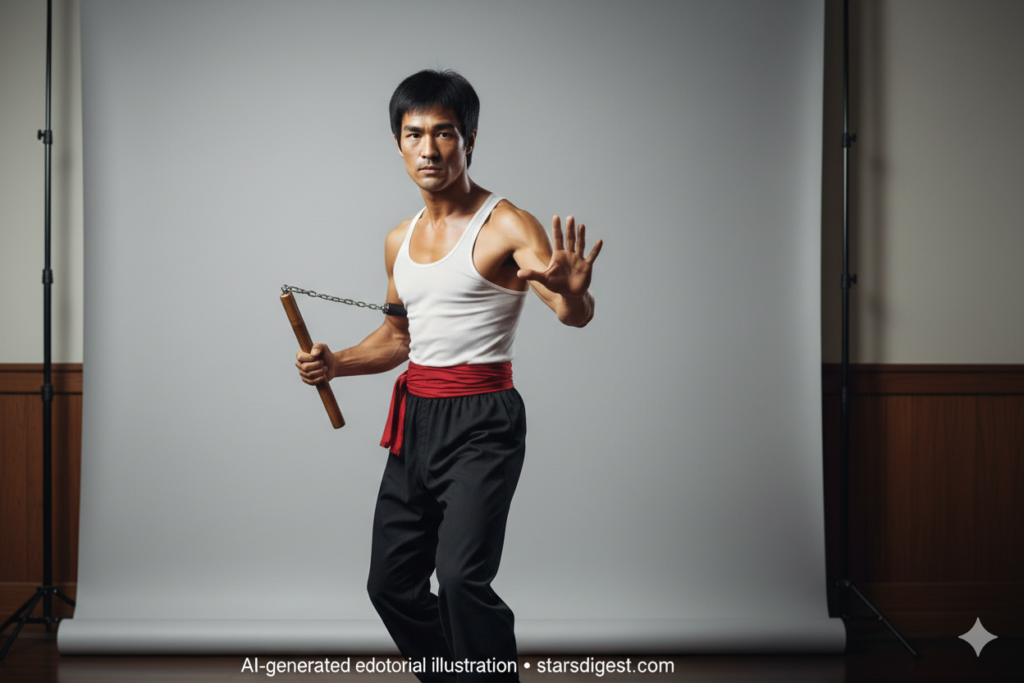
Caption: Hong Kong–American martial artist, actor, and cultural icon
Birth Name: Lee Jun-fan
Born: 27 November 1940
Birth Place: San Francisco, California, United States
Nationality: American (Birth), Hong Kong (Raised)
Other Names: Little Dragon (Childhood nickname)
Occupation: Martial Artist, Actor, Philosopher, Instructor, Filmmaker
Years Active: 1950s – 1973
Height: 172 cm (5 ft 8 in approx)
Spouse / Partner: Linda Lee Cadwell (Married)
Children: Brandon Lee, Shannon Lee
Martial Arts Style: Jeet Kune Do (Founder)
Net Worth: Estimated US $10 Million – $20 Million (modern equivalent adjusted legacy valuation range)
Introduction
Bruce Lee is widely regarded as one of the most influential martial artists in history and one of the most important cultural figures who helped bring Asian martial arts into global mainstream culture. Known for his incredible speed, philosophy-driven approach to combat, and magnetic screen presence, Bruce Lee transformed martial arts from niche cultural practice into worldwide entertainment and lifestyle inspiration.
What made Bruce Lee truly unique was his combination of physical skill, intellectual philosophy, and cultural vision. He was not only a fighter or actor — he was a thinker who challenged traditional martial arts systems and believed in personal expression through movement and discipline. His life story represents breaking cultural barriers, redefining masculinity in action cinema, and proving that discipline and self-belief can overcome social limitations.
Even decades after his passing, Bruce Lee remains one of the most recognized and respected figures in martial arts, film history, and global pop culture.
Early Life and Childhood
Bruce Lee was born on November 27, 1940, in San Francisco while his father, a Cantonese opera singer, was touring in the United States. Shortly after his birth, his family returned to Hong Kong, where he spent most of his childhood. Growing up in Hong Kong exposed him to a fast-moving urban environment, street culture, and early exposure to performance through his father’s entertainment career.
As a child, Lee appeared in several Hong Kong films, gaining early experience in front of cameras. However, outside of acting, his teenage years were challenging. He became involved in street fights and youth gang conflicts, which eventually pushed his parents to encourage formal martial arts training to help him develop discipline and focus.
He began training in Wing Chun martial arts under legendary instructor Ip Man. This training introduced him to the concept that martial arts was not just fighting, but understanding timing, balance, and mental control.
Move to the United States — Reinventing Identity
As a teenager, Lee moved back to the United States, where he continued his education and began teaching martial arts. During this period, he experienced racial barriers and stereotypes in both society and the entertainment industry. Instead of allowing this to limit him, he became more determined to prove that Asian martial artists could be global stars and leaders.
While studying philosophy in college, Lee began forming his own martial arts ideas. He believed traditional martial arts styles were too rigid and did not reflect real combat situations. This belief eventually led him to create his own martial philosophy.
Jeet Kune Do — The Philosophy of Freedom in Combat
Bruce Lee created Jeet Kune Do, a martial arts philosophy focused on efficiency, adaptability, and personal expression. Instead of following fixed patterns, Jeet Kune Do emphasized using what works in real situations.
His philosophy extended beyond fighting. He believed people should remove limitations in life, adapt constantly, and express their true nature. This mindset influenced not only martial artists but also athletes, actors, and entrepreneurs worldwide.
His famous teaching philosophy emphasized simplicity, speed, and mental clarity. He believed that mastery comes from removing unnecessary movement rather than adding complexity.
Hollywood Struggles and Breakthrough
Bruce Lee initially struggled to find major acting roles in Hollywood due to racial stereotypes and limited Asian representation. While he gained recognition through television roles, he was often not given leading roles he deserved based on talent and charisma.
Frustrated by these limitations, Lee returned to Hong Kong film industry, where he finally became a leading action star. His films quickly became massive hits across Asia and later internationally. His fighting style on screen felt real, fast, and emotionally intense, unlike the choreographed fight styles common in earlier action films.
Global Film Stardom and Cultural Revolution
Bruce Lee’s films changed global action cinema. He introduced faster fight choreography, emotional storytelling inside fight scenes, and realistic martial arts technique. His performances made martial arts exciting for global audiences.
He also helped change Western perceptions of Asian masculinity and strength. Before Bruce Lee, Asian male leads were rarely portrayed as strong action heroes in global cinema. Lee broke this barrier permanently.
His films became global cultural events, turning martial arts training into a worldwide movement.
Training Philosophy and Physical Discipline
Bruce Lee trained with extreme intensity. He combined strength training, endurance training, flexibility, and martial arts technique into one system long before modern sports science became popular.
He believed physical training must be combined with mental discipline and philosophical understanding. His training ideas later influenced modern MMA fighters, action actors, and athletic training methods.
Personal Life and Personality
Despite his intense public persona, Lee was known for being deeply philosophical and reflective. He loved reading, writing, and discussing philosophy. He believed martial arts was ultimately about self-understanding rather than dominance over others.
Family was extremely important to him, and he remained deeply connected to his wife and children throughout his career.
Tragic Death and Global Shock
Bruce Lee passed away in 1973 at age 32, shocking the world. His death happened just as he was achieving global superstardom. Despite his short life, his cultural impact was already massive and continued growing after his passing.
His films became legendary, and his philosophy spread globally through martial arts schools, films, and training culture.
Awards and Achievements
Bruce Lee received multiple posthumous honors for martial arts contribution, film influence, and cultural impact. He is widely considered the most influential martial artist in modern global history.
Career Evolution Timeline
Bruce Lee’s life evolved from child actor in Hong Kong to martial arts student, then to martial arts teacher and philosopher, then to global film icon and cultural revolutionary.
Legacy and Historical Importance
Bruce Lee transformed martial arts from traditional cultural practice into global sport, cinema, and philosophy movement. He helped open doors for Asian representation in Hollywood and global entertainment. He influenced modern combat sports, action filmmaking, and personal development philosophy. His message of self-expression, adaptability, and mental discipline continues inspiring millions worldwide.
Conclusion
Bruce Lee’s story is one of discipline, cultural breakthrough, and philosophical influence. From a young boy in Hong Kong street culture to becoming one of the most influential action and martial arts figures in history, his journey reflects the power of belief, training, and vision.
His legacy lives not only in martial arts or film, but in how people think about personal growth, mental strength, and self-expression. Bruce Lee remains one of the most important cultural icons ever produced by global entertainment and sports history.