

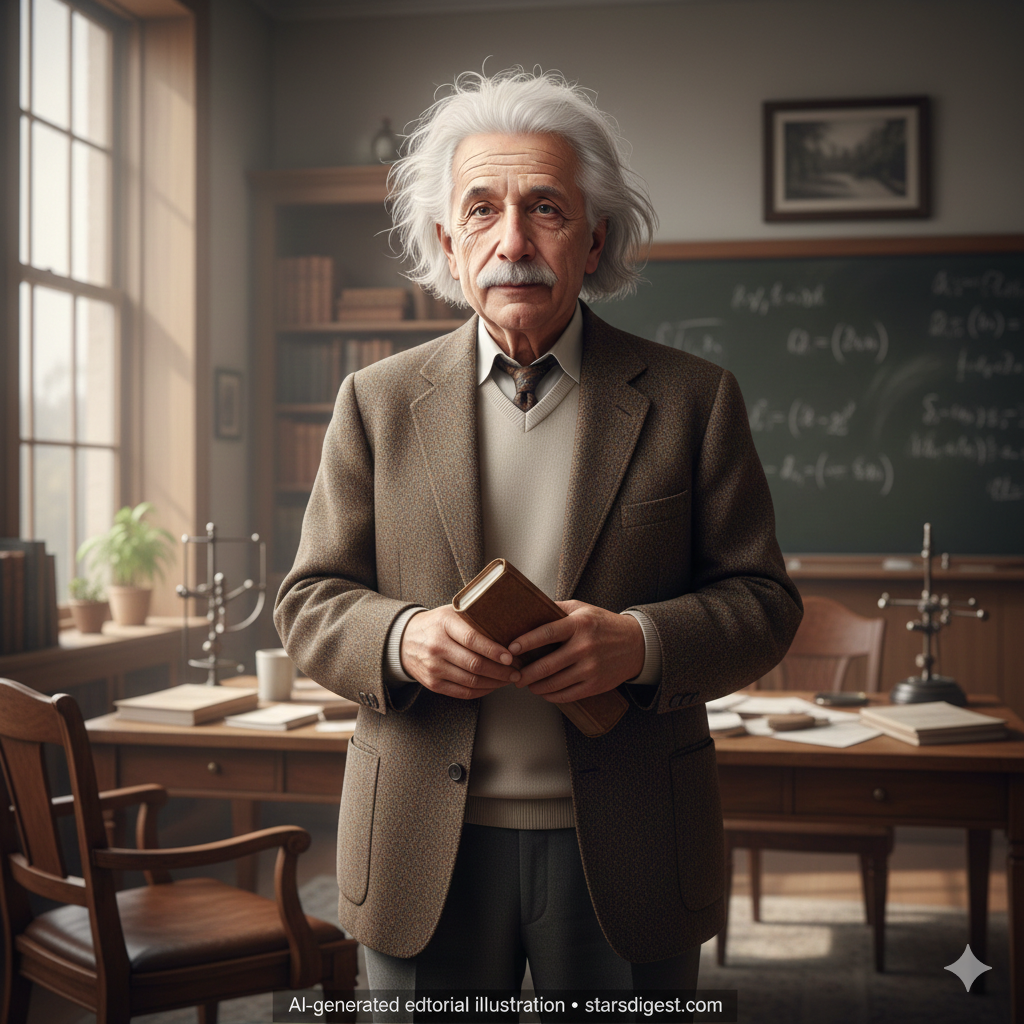
Basic Information
Name: Albert Einstein
Caption: German-born theoretical physicist and creator of modern physics theories
Birth Name: Albert Einstein
Born: 14 March 1879
Birth Place: Ulm, Kingdom of Württemberg, German Empire
Nationality: German (Birth), Swiss (Later), American (Later)
Other Names: Father of Modern Physics
Occupation: Theoretical Physicist, Professor, Scientist
Years Active: 1900 – 1955
Height: Approximately 175 cm (5 ft 9 in approx, historical estimate)
Spouse / Partner: Mileva Marić (First Wife), Elsa Einstein (Second Wife)
Children: Hans Albert Einstein, Eduard Einstein, Lieserl Einstein (historical records debated)
Field: Theoretical Physics
Known For: Theory of Relativity, Photoelectric Effect, Mass-Energy Equivalence (E=mc²)
Net Worth: Not applicable in modern celebrity terms (Academic career; modest personal wealth during lifetime)
Introduction
Albert Einstein is widely regarded as one of the greatest scientific minds in human history and one of the most influential thinkers of the modern era. His work fundamentally changed humanity’s understanding of space, time, energy, gravity, and the structure of the universe. Few individuals in any field have had as deep and lasting an intellectual impact on human civilization.
What makes Einstein’s story extraordinary is that his revolutionary ideas were not developed inside massive research labs or government programs, but often while working ordinary jobs and thinking deeply about how nature works. His ability to imagine complex physical realities using thought experiments changed how science itself approaches discovery.
Beyond science, Einstein became a global cultural symbol of intelligence, curiosity, creativity, and moral responsibility. His image, personality, and ideas helped shape how society views scientists and intellectuals even today.
Early Life and Childhood
Albert Einstein was born on March 14, 1879, in Ulm, in what was then the German Empire. He was raised in a middle-class Jewish family that valued education and intellectual curiosity. His father worked as an engineer and businessman, while his mother encouraged his early interest in music and structured thinking.
As a child, Einstein was quiet and thoughtful rather than socially dominant. Contrary to popular myths, he was not a poor student, but he did struggle with rigid school structures that emphasized memorization over curiosity and independent thinking.
One of the most important moments of his childhood occurred when he was given a compass. Seeing the needle move without visible force fascinated him deeply. This sparked his lifelong obsession with invisible forces and how the universe operates beyond what humans can directly see.
Music also played a major role in his development. He learned violin and often described music as helping him think through complex problems. This combination of art and science became part of his creative thinking style.
Education and Early Intellectual Development
Einstein eventually attended advanced technical schools, where he showed strong ability in mathematics and physics. However, he often clashed with traditional authority structures and rigid teaching methods.
After graduating, he struggled to find academic positions immediately. Instead, he worked at a patent office reviewing technical inventions. Surprisingly, this job helped him develop one of the most powerful thinking habits in science: imagining how systems work from first principles.
During this time, he mentally visualized how light travels, how time behaves at extreme speeds, and how gravity might bend space itself.
The Miracle Year — Scientific Revolution
In 1905, Einstein published multiple scientific papers that would later be called his “Miracle Year” work. These papers transformed multiple areas of physics simultaneously.
He explained the photoelectric effect, helping lay the foundation for quantum physics. He introduced special relativity, showing that time and space are not fixed but relative depending on speed and motion. He also introduced the famous equation E = mc², showing that mass and energy are interchangeable.
These ideas challenged centuries of scientific assumptions and forced scientists to rethink the structure of the universe.
Theory of Relativity — Changing Human Understanding of Reality
Einstein later expanded his work into general relativity, which described gravity not as a simple force, but as the bending of space and time caused by massive objects. This theory changed how scientists understand planets, stars, galaxies, and black holes.
General relativity predictions were later confirmed by astronomical observations, making it one of the most important scientific theories ever created.
Today, modern technologies such as GPS systems rely on relativity calculations, showing how Einstein’s theories directly impact everyday life.
Global Fame and Cultural Icon Status
Unlike most scientists, Einstein became a global celebrity. His distinctive hair, personality, and philosophical thinking made him recognizable worldwide. He was not only respected academically but admired culturally.
He spoke publicly about peace, human rights, global cooperation, and ethical responsibility in science. During major global conflicts and political tensions, he became a moral voice advocating for international cooperation and caution in scientific military applications.
Move to the United States and Later Career
Due to political instability and rising dangers in Europe during the 1930s, Einstein moved to the United States. He accepted academic positions and continued research and teaching while becoming increasingly involved in global intellectual discussions.
During this period, he also became indirectly connected to early nuclear research discussions. Although he supported scientific progress, he later became a strong advocate for nuclear disarmament and peaceful scientific use.
Scientific Thinking Style and Creativity
Einstein’s thinking style was deeply imaginative. He often used thought experiments, imagining himself traveling on beams of light or observing clocks moving at different speeds. This creative visualization allowed him to explore physics problems beyond experimental limitations of his era.
He believed curiosity was more important than memorized knowledge. He often emphasized that asking the right question matters more than immediately finding the right answer.
Personal Life and Personality
Einstein was known for being deeply curious, independent, and sometimes unconventional. He disliked rigid social formalities and often preferred simple living. Despite global fame, he remained focused primarily on intellectual curiosity rather than wealth or status.
He valued close friendships, music, and long walks where he could think deeply about scientific and philosophical questions.
Awards and Achievements
Einstein received major global scientific recognition, including the Nobel Prize in Physics for his explanation of the photoelectric effect. His work became foundational to modern physics, quantum theory development, and space science research.
Career Evolution Timeline
Einstein’s career evolved from curious child fascinated by invisible forces, to patent office thinker developing revolutionary theories, to global scientific leader and cultural intellectual symbol.
Legacy and Historical Importance
Albert Einstein fundamentally changed humanity’s understanding of the universe. His theories shaped modern physics, space science, nuclear science, and technology development. Beyond science, he helped define the global image of the scientist as a creative thinker rather than just a technical researcher. His ideas continue influencing physics, technology, and philosophical discussions about reality itself.
Conclusion
Albert Einstein’s story is one of curiosity, imagination, and intellectual courage. From a quiet child fascinated by a compass to one of the most important thinkers in human history, his journey reflects the power of questioning reality itself.
His legacy continues shaping science, technology, and philosophy across generations. More than a scientist, Einstein became a symbol of human curiosity and the endless pursuit of understanding the universe.