

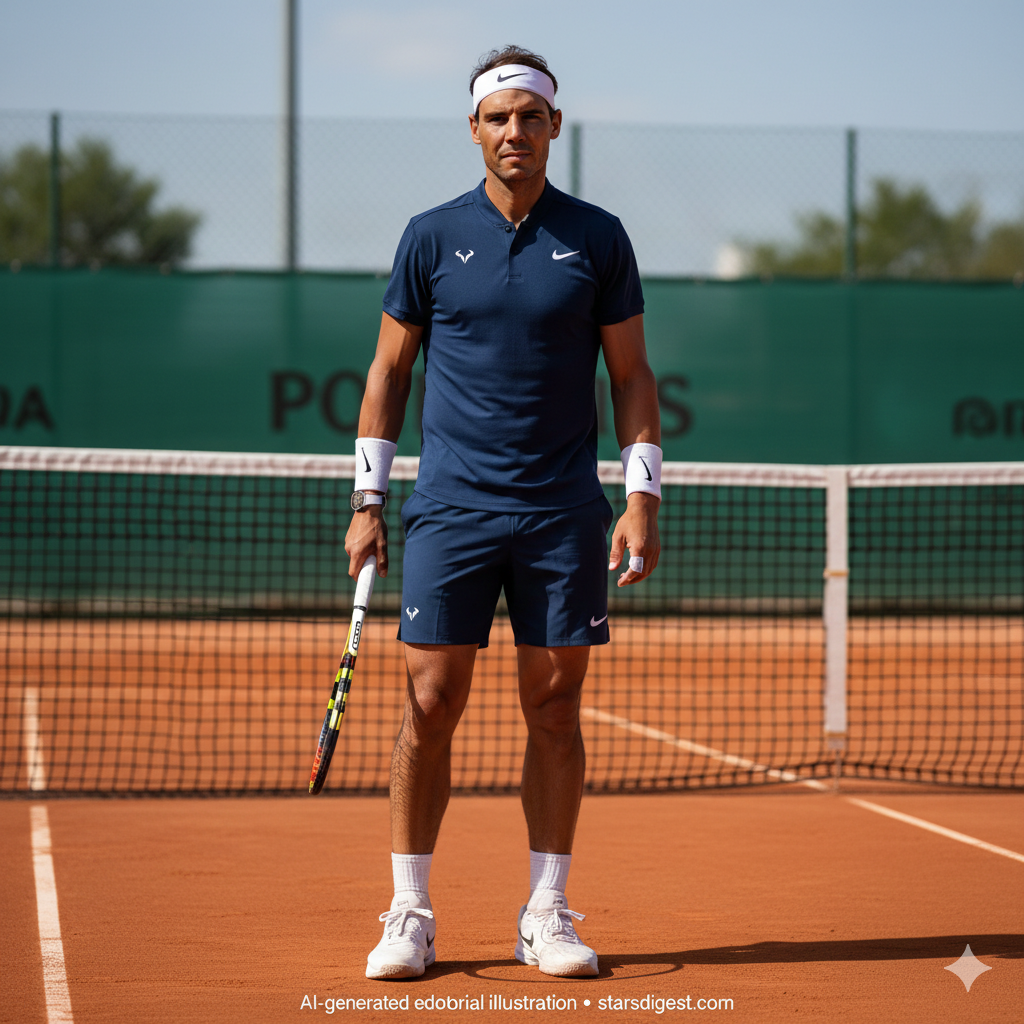
Basic Information
Name: Rafael Nadal
Caption: Spanish professional tennis player and Grand Slam legend
Birth Name: Rafael Nadal Parera
Born: 3 June 1986
Birth Place: Manacor, Mallorca, Spain
Nationality: Spanish
Other Names: Rafa, King of Clay
Occupation: Professional Tennis Player
Years Active: 2001 – Present
Height: 185 cm (6 ft 1 in approx)
Spouse / Partner: Maria Francisca Perelló (Married)
Children: 1 child (born 2022)
Playing Style: Left-handed (two-handed backhand)
Net Worth: Approximately US $220 Million – $260 Million (2025–2026 estimate range)
Introduction
Rafael Nadal is widely regarded as one of the greatest tennis players in history and one of the most mentally tough athletes ever to compete in professional sports. Known for his relentless intensity, unmatched clay-court dominance, physical endurance, and competitive spirit, Nadal built a career defined by discipline, resilience, and emotional passion for the game.
What makes Nadal unique is his combination of physical strength and emotional authenticity. While many champions maintain emotional distance during matches, Nadal is known for showing raw passion, focus rituals, and complete mental immersion in competition. His career represents the idea that mental strength and consistency can be just as important as natural talent.
From a young tennis prodigy in Spain to becoming one of the most decorated Grand Slam champions in history, Nadal’s story is one of persistence, sacrifice, and love for the sport.
Early Life and Childhood
Rafael Nadal was born on June 3, 1986, in Manacor, a small town in Mallorca, Spain. He grew up in a close-knit family environment where sports played a major role in daily life. His uncle, Toni Nadal, became his primary tennis coach and one of the most important influences on his development as both an athlete and a person.
From an early age, Nadal showed strong natural athletic ability. Interestingly, he was talented not only in tennis but also in football (soccer). For a period during childhood, he seriously considered becoming a professional football player before eventually committing fully to tennis.
His training during childhood focused heavily on discipline and mental toughness rather than comfort or convenience. His uncle often emphasized humility, hard work, and emotional control. These early lessons became the foundation of Nadal’s long-term career mindset.
Teenage Breakthrough — Early Professional Success
Nadal entered professional tennis at a very young age and quickly gained attention for his intense playing style. Unlike many young players who take years to adjust to professional competition, Nadal began defeating top-ranked players early in his career.
His early success on clay courts became especially noticeable. His heavy topspin forehand, speed across the court, and defensive recovery ability made him extremely difficult to defeat on slower clay surfaces.
By his teenage years, he was already being discussed as one of the future stars of tennis.
Rise to Global Stardom — The Clay Court Dynasty
Nadal’s dominance on clay courts became one of the most legendary achievements in sports history. His performance at major clay tournaments, especially in France, created one of the most dominant single-surface legacies ever seen in professional sports.
What made his clay dominance unique was consistency. Year after year, he maintained physical intensity and mental focus at levels rarely seen in tennis. His movement on clay courts often appeared almost effortless, allowing him to reach shots other players could not.
This period earned him the nickname “King of Clay,” a title widely accepted across the tennis world.
Expanding Greatness — Success Across All Surfaces
While early in his career Nadal was sometimes labeled as primarily a clay-court specialist, he later proved his versatility by winning major championships on grass and hard courts as well.
His victories across multiple surfaces confirmed his status as one of the most complete tennis players in history. His game evolved to include stronger serving, improved court positioning, and smarter point construction.
Great Rivalries — Defining a Tennis Era
Nadal’s career included some of the greatest rivalries in tennis history. His matches against other top global tennis legends defined an entire era of professional tennis. These rivalries pushed him to continuously evolve physically, technically, and mentally.
Many of these matches are considered among the greatest matches ever played in professional tennis history due to their intensity, endurance, and technical quality.
Playing Style and Competitive Identity
Nadal’s playing style is built around physical intensity, heavy topspin groundstrokes, defensive recovery speed, and mental endurance. His left-handed forehand, especially on clay, is considered one of the most effective shots in tennis history.
His competitive mindset focuses on fighting for every point, regardless of score situation. This mentality helped him win many matches through endurance and psychological pressure rather than pure shot-making alone.
Injury Challenges and Career Longevity
Throughout his career, Nadal faced multiple serious injuries, especially related to knees and foot issues. Many times, analysts predicted his career might end early due to physical wear.
However, Nadal repeatedly returned from injury breaks and continued winning major tournaments. His ability to adapt training methods and playing style helped extend his career longevity far beyond early predictions.
Personal Life and Personality
Nadal is widely known for humility, discipline, and strong respect for opponents and fans. Despite global fame, he maintained a relatively private and grounded personal life.
Family remains extremely important to him, and he often credits his upbringing and early coaching for shaping his character and career mindset.
Business Ventures and Global Brand Influence
Beyond tennis, Nadal built strong global brand partnerships and sports academy projects. His tennis academy focuses on developing young players with strong emphasis on discipline, education, and character development.
Awards and Achievements
Throughout his career, Nadal won multiple Grand Slam championships, Olympic medals, and global tennis awards. He is widely considered one of the most decorated tennis players in history.
Career Evolution Timeline
Rafael Nadal’s career evolved from Spanish tennis prodigy to clay-court global legend, then to multi-surface Grand Slam champion, and finally to veteran tennis icon and global ambassador of the sport.
Legacy and Historical Importance
Rafael Nadal helped redefine physical intensity standards in tennis. He proved that mental resilience and physical endurance can dominate even in highly technical sports. His clay court legacy is considered one of the greatest single-surface achievements in sports history. He also helped inspire a generation of players to focus on fitness, mental strength, and competitive consistency.
Conclusion
Rafael Nadal’s story is one of discipline, resilience, and competitive passion. From a small-town Spanish child with big dreams to becoming one of the greatest tennis champions ever, his journey reflects dedication, humility, and love for competition.
His legacy continues influencing tennis training, sports psychology, and global sports culture. Rafael Nadal remains one of the most respected and admired athletes in modern sports history.